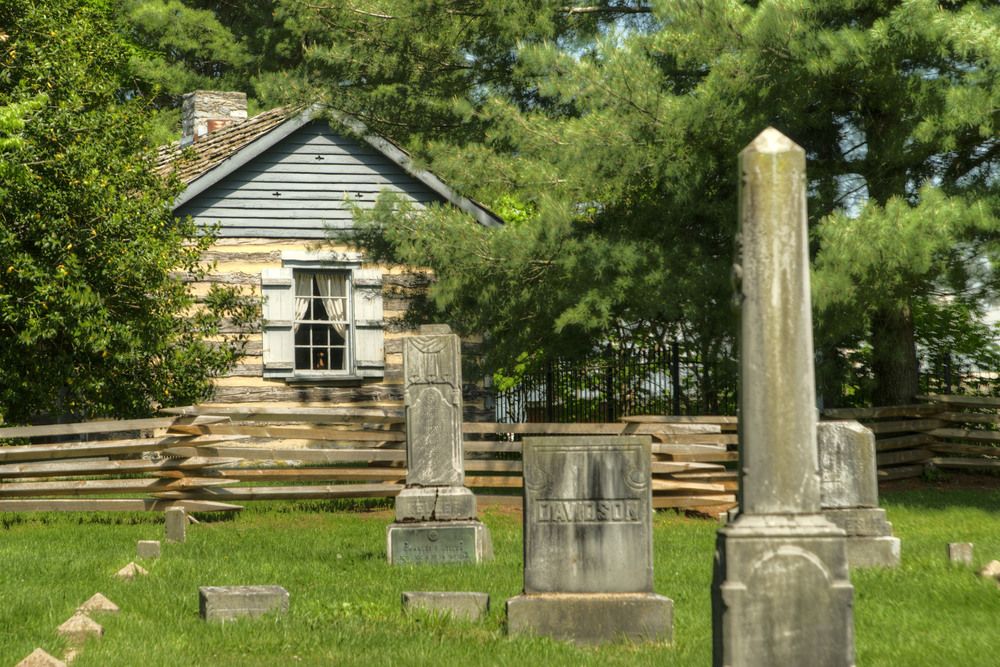
Welcome to the fifth segment of Restoring and Exploring Abingdon! If it’s getting restored, rebuilt, reimagined, or rediscovered—we’re going to talk about it. From historic landmarks getting a new lease on life to community improvements you’ve maybe driven by ten times without noticing, we're here to shine a light on all the good things happening behind the scenes.
For this segment, we’re going to Sinking Spring Cemetery with Senior Town Planner, Gabe Cristofari, to discuss the Adopt-A-Plot program!
Sinking Spring Cemetery is an approximately eleven acre 253-year-old historic site, predating the Town of Abingdon and Washington County both established in 1778. Before incorporation in 1778 the area was known as Wolf Hills and later Black’s Fort, after a fortification of the same name was built “to protect the settlers from Indian attacks.”
The area of the settlement was originally part of a 6,780-acre tract of land granted to Dr. Thomas Walker in 1752. Dr. Thomas Walker was a doctor, surveyor, and land speculator who at one time possessed the land encompassing Sinking Spring Cemetery and much of present-day Abingdon. The area was accessible by the Great Valley Road, which lead from the Shenandoah Valley to the Cumberland Gap, bringing early settlers beginning in the 1760s. By this time, two congregations of Presbyterians had organized in the county, one at Sinking Spring in present-day Abingdon, and the other at Ebbing Spring. In April of 1773, the two congregations organized to call on the Reverend Charles Cummings, who at that time was the Reverend Presby of Hanover and sitting at the Tinkling Spring, in Augusta County, Virginia.
Reverend Cummings accepted the call and “removed his family to the Holston, and settled upon three hundred acres of land on the head waters of Wolf Hill Creek, which he purchased from Dr. Thomas Walker for the consideration of thirty-three pounds, and which was conveyed to him by Dr. Walker by a deed dated April 14, 1774” Reverend Cummings purchased an additional 55 acres of land from Dr. Walker for 55 shillings. The land contained the current acreage of Sinking Spring Cemetery as well as a portion of Fruit Hill and Taylor’s Hill and was deeded by Dr. Walker “to the minister and congregation of the Sinking Spring Church and their successors…” on April 14, 1774.
Soon after receiving title to the land, the congregation erected a log meetinghouse on the grounds of the cemetery, establishing themselves as the earliest Presbyterian congregation in Southwest Virginia. Reverend Cummings served both the Sinking Spring and Ebbing Spring congregations until 1780, after which time he dedicated himself solely to the Sinking Spring congregation. William Henry Creswell died in July of 1776 and was the earliest known burial in Sinking Spring Cemetery. While Sinking Spring Cemetery was established as a burial ground associated with the Sinking Spring Presbyterian Church, it is no longer owned by the congregation.
In an effort to promote community outreach and interaction with Sinking Spring Cemetery, the Town of Abingdon developed an Adopt-A-Plot Program where an individual or group can adopt an enclosed family plot(s) from approximately March/April to September/October, referred to as the mowing season. The Adopt-A-Plot Program allows an individual or group to maintain the landscaping within their adopted enclosed family plot(s) to help maintain this foundational piece of Abingdon’s history. If you are a family member, a person who loves history, wants to contribute to your community, or wants to get outside then this is the program for you!
For more information on Sinking Spring Cemetery Adopt-A-Plot, please visit: Sinking Spring Cemetery Adopt-A-Plot | The Town of Abingdon, Virginia
